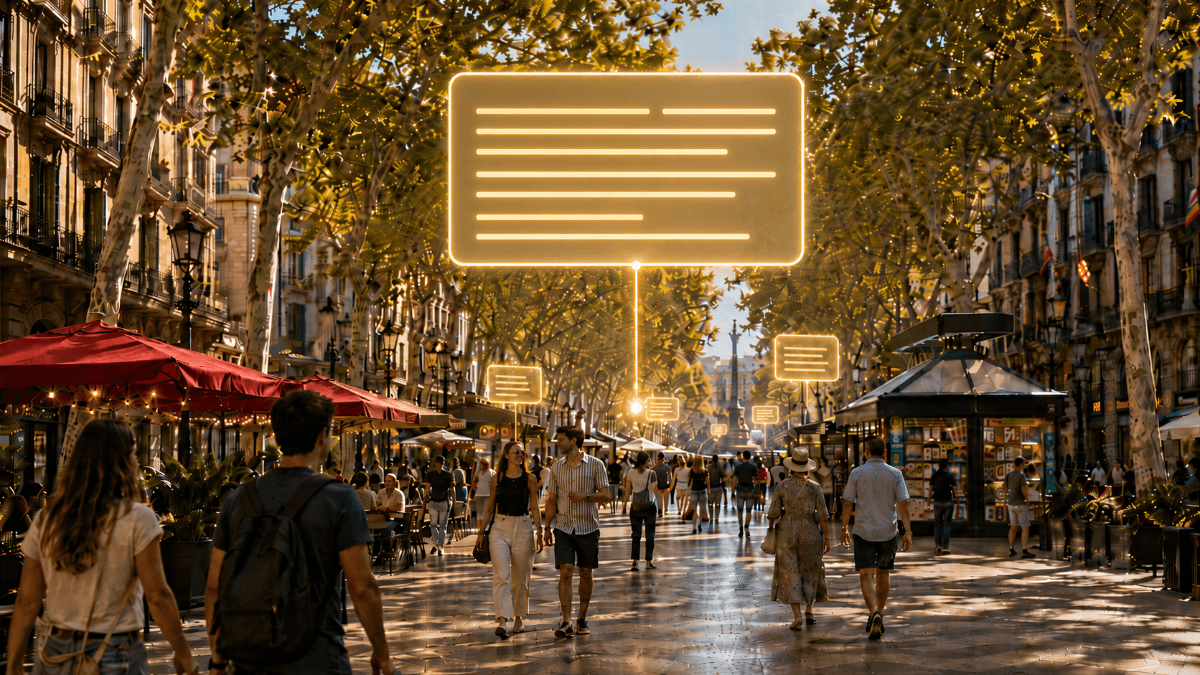
Why post a here-now message
The value of a here-now message comes from connecting location, time, and information — especially when you need to reach people who are currently in or around a specific place.
For example, a lost wallet message can reach people near the area where the wallet was lost. A giveaway message can let people nearby know that a chair is available for pickup. A broken-glass warning at a playground can alert parents, dog owners, and others walking through the area.
This is why here-now messages are built around both place and time. The message is meant for people who are in or around the area while the information is still relevant.
Message about a real need
A good here-now message usually starts from a real need. Someone lost something. Someone found something. Someone wants to give something away. Someone needs quick help. Someone wants to warn others about a problem. Someone wants to find people nearby for something spontaneous.
The message exists because there is a situation connected to a place. It is not content made for attention. It is practical information for people who are close enough to care or act.
That is why here-now messages are usually short, specific, and temporary.
Why here-now messages expire
A spontaneous meetup may matter for one hour. A quick giveaway may matter until the item is gone. A local warning may matter until the problem is fixed. A lost item message may be most useful on the same day.
After the situation is over, the message can become noise. People do not need old local updates when the real-life situation no longer exists.
That is why expiration is part of the idea. A here-now message should stay visible only for the time period set by the person who posts it.
Examples of here-now messages
- "Lost black wallet near the tram stop around 18:30."
- Useful for people who were near that tram stop around that time.
- "Found keys outside Westside Coffee. Describe the keychain."
- Useful for the person who lost them and may still be in the area.
- "Free moving boxes outside Building 12. Pickup before 20:00."
- Useful for people close enough to collect them soon.
- "Broken glass near the playground entrance. Watch your dog or kids."
- Useful for people walking near that playground now.
- "Anyone up for chess in the park for the next hour?"
- Useful for people already close enough to join.
- "Need one person nearby to help carry a table upstairs. Takes 5 minutes."
- Useful for someone who is close and available now.
These messages work because they are clear, local, and time-sensitive. They are not trying to entertain everyone. They are trying to reach the people who can actually do something.
What makes a good here-now message?
A useful here-now message answers three simple questions:
- Where does this matter?
- The location connected to the message.
- When does this matter?
- The moment or time window when someone can act.
- What is happening or needed?
- The situation people nearby should understand.
The clearer these answers are, the more useful the message becomes. A good message does not need to be long. It just needs to be clear to someone in the area.
For example, a message saying "Lost AirPods. White case with blue sticker." makes sense when it is posted at the park where the AirPods were lost.
This works because the place, time, and situation are clear.
A vague message like "Anyone around?" is harder to act on because people do not know what is happening or why they should respond.
How here-now messages are different from other online messages
Online messages are usually made for an audience of followers. A here-now message is made for people who are in an area at a specific time.
If something needs to happen in the real world, a large online audience is not always useful. Sometimes a few people in the right area are more valuable than thousands of random views.
A here-now message does not need to become popular. It needs to reach people nearby.
When here-now messages make sense
They are useful for:
- Lost and found
- Reach people near the place where something was lost or found.
- Quick giveaways
- Find someone close enough to pick something up soon.
- Quick help nearby
- Ask for small, immediate help from someone in the area.
- Spontaneous meetups
- Invite people who are already close enough to join.
- Local warnings
- Share short-term information tied to a specific place.
- Event-area updates
- Tell people around an event what is happening there now.
- Neighborhood notes
- Post practical updates for people in the area.
- Temporary real-life situations
- Make local information visible during the time it can still be useful.
When here-now messages are not the right tool
These messages are less useful when the message is not local or not time-related.
If you need to contact someone you already know, a direct message is better. If you need a long discussion, chat is better. If you are selling something, a marketplace may work better. If there is an emergency, official channels should be used.
But when the question is "how can people in this area see this now?", a here-now message makes sense.
The simple logic behind here-now messages
A here-now message works because it connects online information to real-life context:
- Something is happening here
- The post belongs to a real place.
- It matters at this time
- The information is connected to a moment or time window.
- Someone in the area may be able to act
- The right people are close enough to help, join, notice, pick up, or avoid a problem.
That is the core idea: here-now messages connect useful information to a place and time, so people in that area can notice it and act.